

Two Weeks Apart
In Russia, they stood in the rain to learn about Jewish life. In London and Rome, institutions decided that was too much trouble to protect.

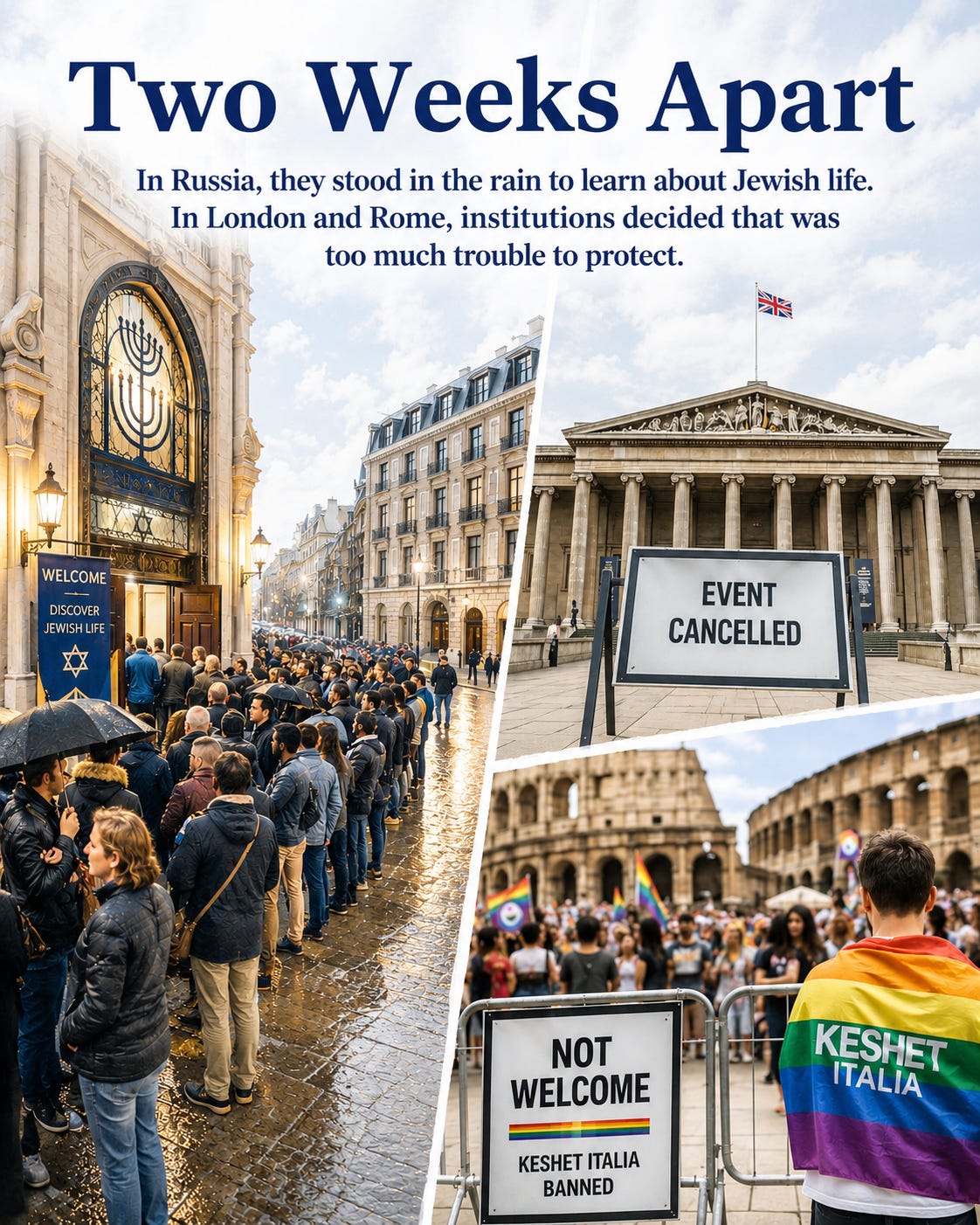
Two weeks ago on a Saturday night, more than 1,000 people stood in the pouring rain outside a synagogue in Rostov, Russia and waited for over an hour to get inside.
They weren’t there for a protest or because someone forced them to show up. They were there because the city was holding its annual Museum Night, the local Chabad community had opened the doors of their historic synagogue to the public and people showed up in numbers nobody expected. The crowd grew so large the evening had to be split into two sessions. Inside, visitors tasted matzah, stood under a chuppah, learned what a Jewish wedding looks like, heard Havdalah, saw Torah scrolls up close, and asked questions about Shabbat, kosher food, mezuzahs, and Jewish education until almost two in the morning. The ones answering those questions were Jewish students from the community itself.
This is Rostov. A city where the last time crowds surrounded that synagogue in large numbers was in 1905 during a pogrom.
At around the same time, over in London, the British Museum cancelled a lecture called Ancient Israel and Judah in the British Museum, scheduled as part of the United Kingdom’s first-ever Jewish Culture Month. The museum didn’t cancel because anything actually happened. It cancelled after organizers learned that a large number of registered attendees were planning to deliberately disrupt the event. The threat alone was enough. Historian Simon Schama called the decision “cowardice.” Veteran BBC journalist John Simpson called it “pathetic.” The museum said it acted to protect the event, not diminish it. That argument would carry more weight if the effect weren’t exactly the same either way.
And at the same time over in Italy, Rome Pride barred Italy’s only Jewish LGBT group, Keshet Italia, from joining its annual parade. The reason? Keshet Italia hadn’t condemned Israel’s actions in Gaza as genocide. No other group participating in the parade was subjected to this test. Keshet Italia called it what it was…a political loyalty exam applied exclusively to Jews. Ariel Heller, the president of Keshet Italia said: “As Jews, we’re not responsible for everything that the government of another country does. This was just a way for them to remove our organization and our community. This is Europe in 2026 and Jews still have to fear taking part in a Pride parade in Italy.”
These three stories broke in the same news cycle. Together they say something that none of them says alone.
The British Museum cancellation didn’t happen by itself. It lands inside a stretch of violence and institutional failure in the United Kingdom that’s been accumulating for two years. In March 2026, four Hatzola ambulances were destroyed by arson in the car park of Machzike Hadath synagogue in Golders Green. That same month, two men were charged under the National Security Act for conducting surveillance of Jewish individuals and locations on behalf of Iranian intelligence. Counter-terror police confirmed that Iranian state actors are directing operations on British soil, with Jewish communities in Harrow and Barnet among the targets. A father and son were stabbed outside their synagogue in April by an attacker shouting antisemitic slogans. Weekly marches have moved through the capital for over a year.
And now a museum that holds the Rosetta Stone has decided it can’t safely host a lecture about ancient Jewish kingdoms.
What the British Museum did was send a signal to the haters. When a publicly funded national institution decides that the right response to a threatened disruption of a Jewish cultural event is cancellation, it tells everyone watching exactly what works. The mob doesn’t need to show up anymore. It just needs to make a call.
The Rome situation is different in form but connected in logic. Pride movements were built on the principle that no minority should have to justify their presence in public life or prove the acceptability of their identity before being allowed in. That principle is now being applied selectively. No other group at Rome Pride was asked to publicly denounce a foreign government before being permitted a float. Keshet Italia was told it could still march, just without one. The line between inclusion and exclusion was drawn exactly around the Jewish organization, and the people drawing it called it a matter of principle.
That’s what conditional tolerance looks like. It rarely announces what it is.
And then there’s Rostov.
Rostov isn’t a city anyone holds up as a model of democratic freedoms. Russia isn’t a country anyone would point to as a safe place for minority communities. And yet on a rainy Saturday night in May, a thousand non-Jewish Russians waited in the rain to learn about Jewish life, listen to Havdalah, and ask questions about how Jewish families live. One man pulled a community leader aside and said his mother and grandmother had been Jewish, that his family had converted under pressure generations ago, and that he was ready to come home.
In a city shaped by pogroms, Jewish life was celebrated openly and with full civic welcome. In London and Rome, two cities that consider themselves among the most liberal on earth, Jewish cultural events were cancelled or restricted in the same week.
The institutions and movements that’ve spent years positioning themselves as defenders of minority rights are the ones stepping back. Not because they were forced to. Nobody stormed the British Museum. Nobody physically blocked Keshet Italia from the parade route. These were decisions, made by people who weighed the cost of holding firm and decided that giving in was easier. Every time that calculation gets made, it confirms for the people applying pressure that pressure works. And it tells Jewish communities, in plain terms, that the institutions claiming to protect them won’t actually do so when it becomes inconvenient.
On a rainy Saturday night in Rostov, a man who’d spent his entire life hiding his Jewish identity decided he was ready to embrace his Jewish identity.
In London and Rome, publicly funded institutions decided the opposite.
Sources
British Museum cancels Jewish Culture Month lecture over disruption fears — The Jewish Chronicle, May 28, 2026 https://www.thejc.com/news/uk/british-museum-cancels-jewish-culture-month-disruption-sk7z0cu1
British Museum postpones Jewish Culture Month lecture — Jewish Telegraphic Agency, May 28, 2026 https://www.jta.org/2026/05/28/global/british-museum-postpones-a-jewish-culture-month-lecture-citing-disruption-concerns
“Pathetic cowardice” — British Museum postpones Jewish cultural event — Jewish News, May 28, 2026 https://www.jewishnews.co.uk/british-museum-postpones-celebration-of-jewish-culture-over-protest-fears/amp/
Rome Pride bars Italy’s only Jewish LGBT group from parade — The Jewish Chronicle, May 28, 2026 https://www.thejc.com/news/world/rome-pride-bans-italys-only-jewish-lgbt-group-from-attending-unless-it-condemns-israel-exe9rhil
Rome Pride bars Jewish LGBT group over Gaza stance — Reuters via U.S. News, May 28, 2026 https://www.usnews.com/news/world/articles/2026-05-28/rome-pride-bars-jewish-lgbt-group-from-parade-over-gaza-stance
I shouldn't have to say "Don't blame me for what Israel is doing." I should be able to say, "I approve what Israel is doing. Given what Israel is up against — an intransigent enemy who will not stop committing atrocities until all Israelis are dead or gone and which does nothing to protect its own people — Israel is doing a better and more moral job than any other country in the world."
This is no longer surprising. You could hold the same event in China and it would be safe. It’s the elephant in the room. What do these 2 countries have in common regarding certain groups?
Should Jews be contemplating adding the above mentioned to their Plan B?
It is ironic for Jews to now be safer in Russia. And China opened their doors to Jewish immigrants escaping the Holocaust.