

The List Keepers
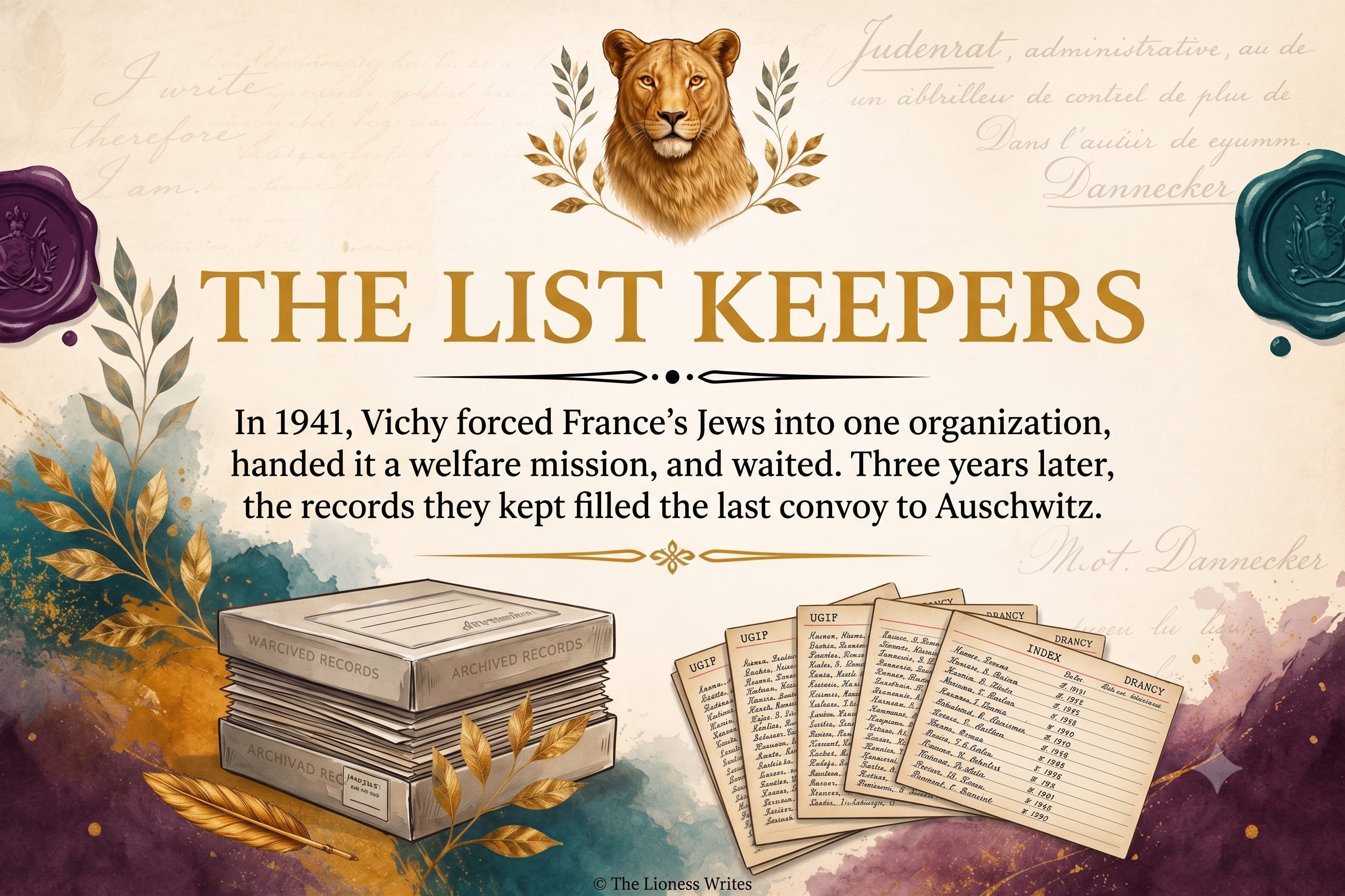
In 1941 Vichy forced France's Jews into one organization, handed it a welfare mission, and waited. Three years later, the records they kept filled the last convoy to Auschwitz.

The Trap Is Designed
The Germans had a word for what they wanted. They’d used it in Warsaw and Vienna and Amsterdam. Now, in the fall of 1941…they wanted it in Paris. The word was Judenrat. A Jewish council. One body, one address, one set of names they could call when they needed something done.
Theodor Dannecker was thirty years old and had been working for Adolf Eichmann since he was twenty-four. He was precise, efficient, and emotionless about his work. As head of the Gestapo’s Office for Jewish Affairs in Paris, his job was to implement the Final Solution in France, and one of the first things he understood was that it couldn’t be done cleanly without an administrative intermediary. There were around 300,000 Jews of France who were scattered across two zones — the German-occupied north and the so-called Free Zone in the south, still technically governed by the French under Marshal Pétain from the resort town of Vichy. They spoke different languages, came from different countries, worshipped in different ways. There were the old French Jewish families, the Israélites who had lived in France for generations and considered themselves thoroughly French. There were also the immigrants — the Poles, the Russians, the Germans and Austrians who had fled east European poverty or Nazi persecution and arrived in France between the wars. These two communities barely recognized each other as the same thing. Getting them into a single room was hard enough. Getting them onto a single list was another matter entirely.
In early 1941, Dannecker tried first, pushing for a coordinating committee of Jewish welfare organizations in Paris. In April 1941 the Comité de Coordination des Oeuvres de Bienfaisance du Grand Paris was formally declared. As a tool of control, it failed almost immediately. The established community leaders wouldn’t play the role Dannecker needed. They cooperated on charity work and nothing else.
So Dannecker went to Xavier Vallat.
Vallat was sixty-one years old, one-eyed, one-armed, and had been a vocal antisemite in the French parliament since the 1920s. He was now the Vichy government’s Commissioner for Jewish Affairs, a position he’d pursued with the enthusiasm of a man who had trained and waited his entire career for this exact job. He didn’t need the Germans to tell him to hate Jews. He’d been doing that on his own for decades. He understood that Dannecker’s request, create a centralized Jewish organization that would serve also serve French interests, on that would give France control. If the Germans were going to impose a Jewish council regardless, better that it be a French Jewish council run under French supervision that answered to French authorities. The alternative was a purely German operation which would have been a humiliation to the collaborationist government that still believed with increasingly desperate sincerity that it was managing the occupation rather than being consumed by it.
On November 29, 1941 the Vichy government issued a law creating the Union Générale des Israélites de France. The UGIF.
The law was three pages long and clinical in its language. The UGIF would represent Jews before public authorities. It would handle matters of assistance, welfare, and social reintegration. All existing Jewish organizations in France…every charity, mutual aid society, and religious welfare body were formally dissolved with all their assets transferred to the new organization. Membership was not optional. Every Jew in France automatically belonged to the UGIF…whether they wanted to or not.
The trap was built. Now they needed someone to run it.
This work is entirely reader-supported. By choosing a paid subscription, you allow me to continue this long-form research to bring these vital stories to light. Thank you for helping this Lioness roar for the truth.
