
The Code They Couldn’t Burn
The Secret History of Crypto-Judaism in the New World

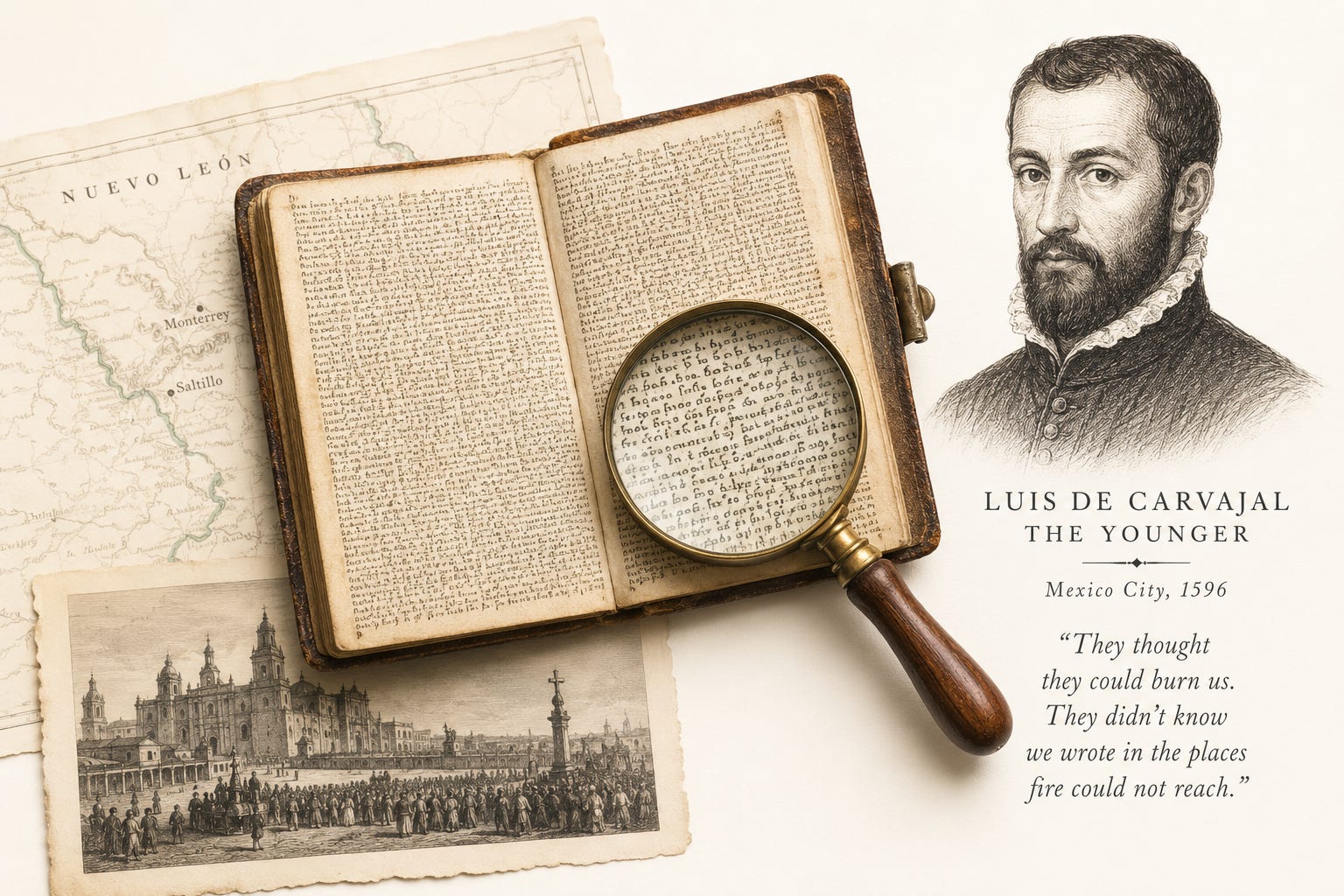
In July 2016, a small leather notebook appeared in the auction catalog at Swann Galleries in New York City. It was listed under the heading “Colonial Religious Manuscript,” the kind of label designed to make you skip it.
Leonard Milberg didn’t skip it.
Milberg was a collector of Judaica, a Princeton graduate, and the kind of person who reads auction catalogs the way other people read newspapers. He saw the listing, went to the gallery to look at it in person, and felt his stomach drop. He recognized the handwriting: microscopic, precise, packed so tightly onto the page that you’d need a magnifying glass just to confirm it was writing at all. He knew exactly what this was. A palm-sized manuscript written in a dungeon, hidden beneath a condemned man’s hat and behind a wall in his house, stolen from a national archive in 1932, and passed quietly through the black market for eighty-four years while scholars assumed it was gone forever.
He called the Mexican consulate. He sat across from Consul Diego Gomez Pickering and spent forty minutes explaining the history of crypto-Judaism and why what was sitting in a New York auction house belonged to Mexico. The gallery pulled the items from sale. Scholars authenticated them. Through diplomatic channels, Milberg arranged the repatriation. The Mexican government later gave him the Order of the Aztec Eagle, the highest honor Mexico extends to foreign nationals.
The manuscript went home.
It now sits behind glass at the National Museum of Anthropology in Mexico City.
The man who wrote it was Luis de Carvajal the Younger. He was twenty-nine years old when the Inquisition burned him alive in Mexico City’s central plaza.
The people who lit that fire believed they were erasing something. They weren’t. They were preserving the final piece of one of the most astonishing survival stories in Jewish history, a story that begins with a brutal ultimatum in Spain in 1492, runs through the desert frontier of northern Mexico, gets passed in whispers from mother to daughter for three centuries, and surfaces in a genetics lab in Texas five hundred years later.
A Choice with No Good Options
Luis de Carvajal didn’t end up in the Mexican desert by accident. His family had been running for a hundred years before he was born.
In 1492, the same year Columbus set sail, the Spanish Crown issued the Alhambra Decree. Jews living in Spain were given thirty days to convert to Christianity or leave. An estimated 100,000 to 200,000 people chose exile. Many of those who stayed converted — publicly, officially, with a priest and a baptism and a new Christian name. Outwardly they became New Christians. Privately, a significant number stayed Jewish. They kept Shabbat behind closed doors. They said the old prayers in hushed voices. They raised their children in two worlds at once.
Many of those who fled went to what looked like the safest option: Portugal, right next door.
It was not safe.
This work is entirely reader-supported. By choosing a paid subscription, you allow me to continue this long-form research to bring these vital stories to light. Thank you for helping this Lioness roar for the truth.
