

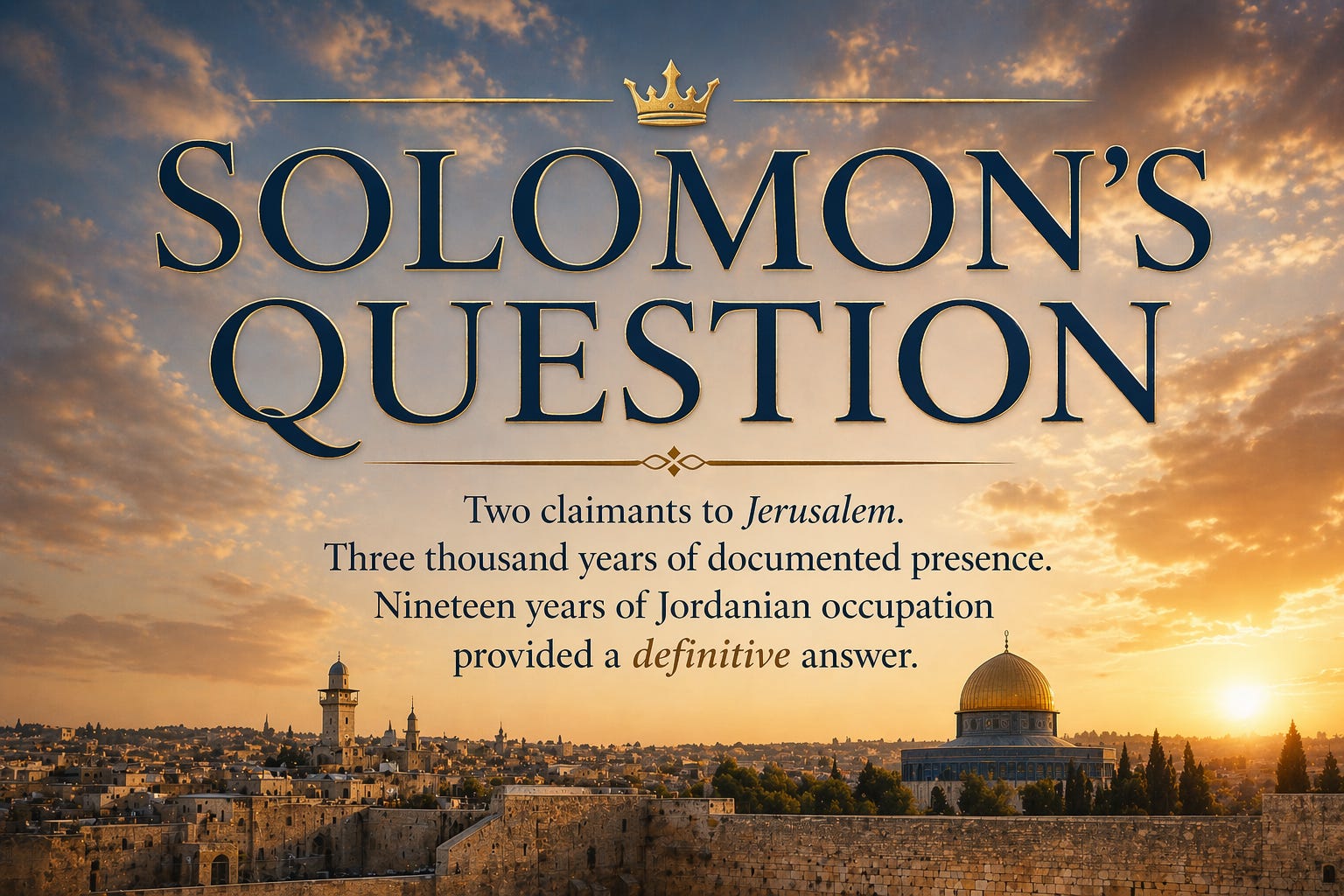
Solomon's Question
Two claimants to Jerusalem. Three thousand years of documented presence. Nineteen years of Jordanian occupation provided a definitive answer.

There is a story, older than most nations, about two women who both claimed the same child. A king heard them both. He proposed cutting the child in two and giving half to each. One woman agreed. The other said give the child to her rival instead, let her have it whole and alive, rather than see it destroyed.
The king gave the child to the woman who chose life over possession.
His name was Solomon. He sat in judgment in Jerusalem. The Temple he built there stood for four centuries before the Babylonians destroyed it. The Second Temple rose in its place and stood for another five hundred years before Rome burned it to the ground.
The Western Wall is what remains.
The question Solomon asked that day has never stopped being answered. Who acts like a true keeper, and who would rather see something destroyed than let someone else hold it? Between 1948 and 1967, Jordan held the Old City of Jerusalem. What they did with it for those 19 years is documented in detail, including by the Jordanian commander who directed it.
Before the War
At the end of 1947, Jerusalem had approximately 100,000 Jewish residents and 65,000 Arab residents. In the Jewish Quarter of the Old City, about 2,500 Jews lived in a small, fortified neighborhood and faced frequent harassment from Arab neighbors, while the British Mandate authorities often failed to intervene.
The UN partition vote passed on November 29, 1947. The next day, population movement began. Jewish residents left Arab neighborhoods in the east. Arab residents began leaving Jewish neighborhoods in the west. A buffer zone of abandoned streets formed between the two populations near the Old City, in neighborhoods like Yemin Moshe, Kiryat Shmuel, and Shimon HaTzadik. The city was fracturing before the war had officially started.
The Siege
Once the UN vote passed, conditions inside the Old City deteriorated fast. Arab forces imposed a siege on the Jewish Quarter, cutting off food and ammunition. The Yishuv leadership smuggled in Haganah fighters and weapons, but the numbers were never in their favor.
On May 17, 1948, Jordanian forces advanced through the Jewish Quarter street by street. The defenders slowed their progress but could not hold out. They ran out of food, ammunition, and manpower. The Jordanian force was organized, well-equipped, and nearly six times larger than the Jewish defenders.
When surrender was first raised, the Quarter’s commander, Moshe Rusnak, refused. As ammunition ran out, a delegation of rabbis led by Rabbi Weingarten walked out to meet the Jordanians. They went to discuss the evacuation of the wounded. They came back with an unconditional surrender.
On May 28, 1948, the Jewish Quarter of the Old City fell to the Arab Legion, Jordan’s professional military force, trained, commanded, and funded by the British.
The British Hand
The Arab Legion was commanded by Lieutenant General John Bagot Glubb, a Lancashire-born officer known as Glubb Pasha. At the time of the battle, virtually every senior officer above the rank of company commander was a British national, most being veterans of the Second World War. Over thirty years, Britain had built the Arab Legion into the most effective Arab fighting force in the region.
When the British government grew embarrassed by its own officers fighting a foreign war, it ordered them home. Every one of them crossed back and rejoined their units.
This work is entirely reader-supported. By choosing a paid subscription, you allow me to continue this long-form research into the history that gets buried and bring these vital stories to light. Thank you for helping this Lioness roar for the truth.
