

Inside the Crematoria
They Were Forced to Run the Gas Chambers. Then They Blew One Up.

4:00 p.m., Oct. 7, 1944
The plan was to start at 2:00 p.m.
The SS got there first.
At 1:00 p.m., German soldiers appeared at Crematorium IV in Auschwitz-Birkenau and called a roll call. They read out 100 prisoner numbers. The men whose numbers were called would be “transported.” Everyone in the yard knew what that meant. They had been the ones doing the transporting.
The prisoners looked at each other. They looked at the fence. They looked at the explosives they had spent 18 months smuggling into the camp one teaspoon at a time.
They made a choice.
What the Sonderkommando Were
Sonderkommando means “special unit.” The name is clean and bureaucratic, which was the point. The reality was something the human mind resists taking in even now.
They were Jewish prisoners selected on arrival at Auschwitz-Birkenau. Their job was to run the machinery of the killing. They led new arrivals from the train platform to the gas chambers, telling them they were going to shower. They waited outside while the gas was pumped in. Then they went in and cleared the bodies. They extracted gold teeth. They cut the hair. They sorted the belongings. They loaded the corpses into the crematoria and shoveled the ashes.
If they refused, they were shot.
If they survived long enough to know too much, they were shot anyway. The Nazis regularly liquidated Sonderkommando detachments and replaced them with new arrivals, deliberately cycling men through so no single group could accumulate enough knowledge to testify. Over the course of the war, more than 3,400 people were forced into these units at Auschwitz alone.
The system was designed that way on purpose. The Nazis wanted the Jews of Europe implicated in their own destruction. They wanted the line between perpetrator and victim blurred beyond recognition. They wanted to make sure that if anyone survived to tell the story, nobody would believe them.
What they didn’t account for was that some of the men they forced into that role were keeping records.
The Man Who Wrote It Down
Zalmen Gradowski was a poet and scholar from Suwalki, Poland. He arrived at Auschwitz in December 1942 with his wife, his mother, his sisters and his mother-in-law. He watched them all go into the gas chamber. He was pulled out of the line and assigned to the Sonderkommando.
He spent the next two years writing.
He wrote in Yiddish, in secret, in the moments between the work the Nazis forced him to do. He wrote about what he witnessed. About the people who arrived on the trains not knowing what was about to happen. About the families separated on the platform. About the gas chamber and what came after. He wrote it all down in precise detail because he understood that he was the only record these people would ever have.
He figured he was going to die anyway, he just didn’t know when. So he buried the manuscripts in the ground near Crematorium III, sealed in a container, where they might survive even if he didn’t. On the outside of the container he wrote a message to whoever might one day find it:
“Dear finder, search everywhere, in every inch of soil. Dozens of documents are buried under it, mine and those of other persons, which will shed light on everything that happened here.”
Then he started planning the revolt.
The Photographs
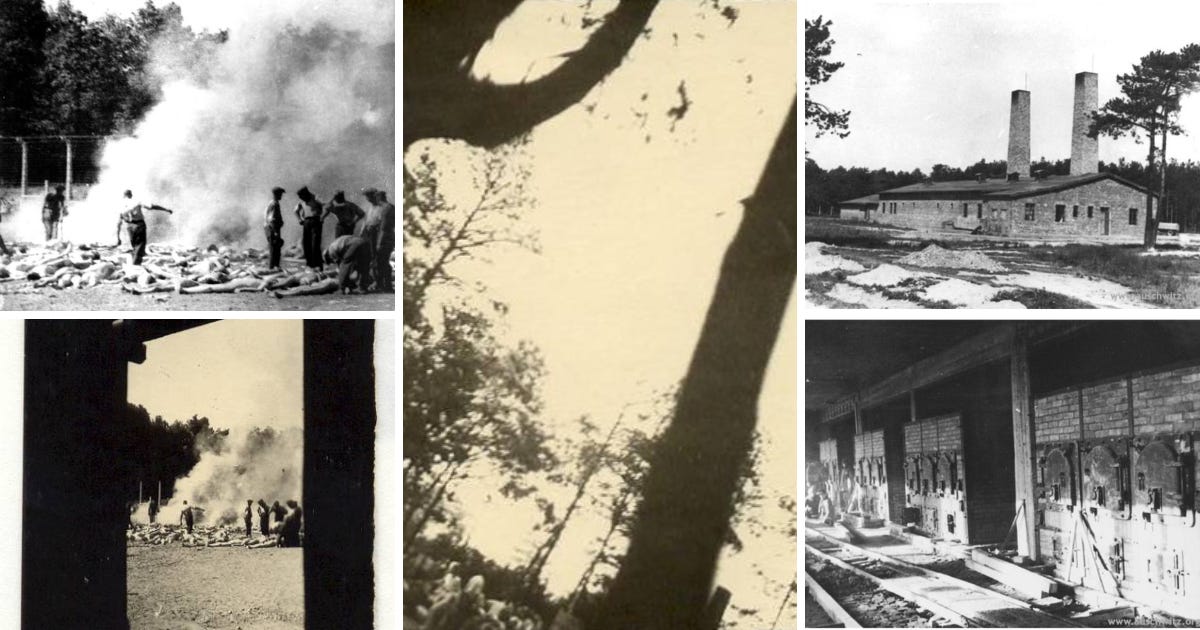
In August 1944, two months before the uprising, a Sonderkommando member named Alberto Errera, a Greek Jewish military officer, took four photographs inside Auschwitz-Birkenau while another member, Alter Fajnzylberg, kept watch.
Errera shot from the hip, unable to aim with any precision. Two photographs were taken from inside a gas chamber looking out. Two were taken outside, showing bodies burning in open pits in the ground, used when the crematoria couldn’t keep pace with the volume of killing. The images are blurred and difficult. They are also the only photographs ever taken by prisoners inside the camp.
The Polish resistance smuggled the film out of Auschwitz rolled inside a toothpaste tube. The original uncropped versions of the photographs were not recovered until 1985. They are held today by the Auschwitz-Birkenau State Museum.
The Women in the Factory
The men of the Sonderkommando had almost nothing. No weapons. No access to the outside. No way to get explosives into a facility under constant SS guard.
What they had was a network.
Roza Robota was 23 years old, born in Ciechanow, Poland, a member of the Ha-Shomer ha-Za’ir Zionist youth movement before the war. She arrived at Auschwitz-Birkenau in 1942 and was assigned to the clothing detail, sorting and distributing the belongings of people who had just been killed. The location gave her access to both the men’s and women’s sections of the camp. She became a resistance liaison.
Inside the camp’s Weichsel-Union-Metallwerke munitions factory, Jewish women were forced to manufacture detonators for artillery shells. Three of them, Ala Gertner, Regina Safirsztajn and Ester Wajcblum, worked in the section responsible for producing gunpowder. They were searched every day when they left the factory.
They did it anyway.
Teaspoon by teaspoon. Day by day. For more than six months. They rubbed gunpowder onto their bodies, hid it in the hems of their dresses, packed it into handkerchiefs and matchboxes. Between one and three teaspoons a day, passed from hand to hand through a chain of roughly 20 women, through the clothing detail, to Roza Robota and then to the men of the Sonderkommando.
Ester’s younger sister Hanka was part of the chain too. She knew what she was carrying. She knew what happened to people who got caught.
The men buried the gunpowder near the crematoria and waited.
The Plan
It took over a year to accumulate enough.
The Sonderkommando coordinated with the broader Auschwitz underground, which included Polish political prisoners and a resistance network that stretched outside the camp walls. The full plan called for a simultaneous uprising across all four crematoria. They would blow up the gas chambers, cut through the electrified fence and escape into the surrounding forests where the Polish partisans would be waiting.
By the autumn of 1944 they had run out of time.
The Soviet Army was advancing across Poland. The Nazis were liquidating evidence. In the months before Oct. 7, the SS had already executed hundreds of Sonderkommando members to prevent testimony. The men who remained understood they were next. Word came through the underground that another 300 were about to be selected.
The night before the revolt, the SS officer Otto Moll, who presided over the crematoria with a reputation for sadism that stood out even in Auschwitz, grew suspicious. He dragged Yaacov Kamiński, one of the Sonderkommando resistance leaders, outside and interrogated him. When Kamiński refused to give up anything, Moll shot him.
The remaining men received the news that night. The planned start time of 2:00 p.m. the next day held.
Oct. 7, 1944
At 1:00 p.m. the SS moved first.
When the soldiers began reading prisoner numbers at Crematorium IV, the men didn’t wait for the coordinated signal. They attacked with what they had: axes, knives, stones and the makeshift grenades assembled from the smuggled gunpowder and tin cans. They threw them at the SS guards. They set fire to the building. They packed the explosives into Crematorium IV and blew it apart.
The explosion ripped through the structure. Three SS guards were killed. More than ten were wounded. The men at Crematorium II heard the blast and rose up as well, cutting through the electrified fence, which was not yet live in the afternoon, and running for the tree line.
The coordinated uprising at Crematoria III and IV never happened. The signal never reached them in time.
The SS called in reinforcements and surrounded the escapees in the fields beyond the fence. Every prisoner who got out was hunted down and killed. Back inside the camp, 250 men died fighting. The SS executed 200 more in the days that followed.
Crematorium IV never operated again. Crematorium II sustained serious damage as well, and the SS themselves demolished what remained of it in the weeks that followed as they worked to destroy the evidence of what had happened there.
The Investigation
The Nazis knew the explosives had come from inside their own factory.
They interrogated dozens of terrified prisoners. Slowly the chain led them to four names. Roza Robota. Ala Gertner. Regina Safirsztajn. Ester Wajcblum.
The four women were arrested and tortured. The SS interrogators wanted the full network. The names of everyone involved. The chain of 20 women who had passed gunpowder day by day for six months. All of it.
The four women gave them nothing. The network held. Ester’s sister Hanka, who had been part of the chain, was never identified. She survived the war and was liberated from Neustadt-Glewe in May 1945. Much of what we know today about how the smuggling operation worked came from her testimony.
Jan. 6, 1945
The four women were publicly hanged in two separate ceremonies, one for the day shift and one for the night shift, so that every prisoner in the camp would see what happened to those who resisted.
As Roza Robota was walked to the gallows, she sang Hatikvah. Her final message, smuggled out of her cell before the execution, was four words: be strong and courageous.
Twenty-one days later, on Jan. 27, 1945, the Soviet Army liberated Auschwitz.
What Was Found in the Ground
After the war, workers excavating near the ruins of Crematorium III found a buried container. Inside were the manuscripts of Zalmen Gradowski. Everything he had written in secret over two years. The testimonies of the people who had arrived on the trains. The names. The faces. The details he had committed to paper knowing he would likely never survive to deliver them himself.
More manuscripts were found in subsequent excavations, written by two other Sonderkommando members, Lajb Langfus and Zalman Lewental. Together the scrolls form the only first-person testimony of what happened inside the crematoria of Auschwitz, written by the men who were forced to be there.
Gradowski died in the revolt on Oct. 7, 1944. He was right that he wouldn’t survive. He was also right that the manuscripts would.
What It Cost and What It Meant
The numbers are stark. The revolt killed three SS guards and wounded ten. It destroyed one crematorium. Four women were hanged. Roughly 450 Sonderkommando members were killed in the revolt and its aftermath.
By any military measure it was a failure.
That misses the point entirely.
These were men forced into the most degrading position the Nazi system could devise, made to participate in the killing of their own people, stripped of every form of dignity and agency. The system was built to break them, to make resistance unthinkable, to leave them with nothing.
They spent 18 months proving the system wrong. They built a network inside a death camp. They coordinated with women who smuggled gunpowder a teaspoon at a time past daily SS searches. They buried their testimony in the ground so the world would know what happened there. And when the moment came, they fought with axes and tin cans against an SS garrison and blew up a crematorium inside Auschwitz itself.
Every one of them knew they were not going to survive. They fought anyway.
Sources
United States Holocaust Memorial Museum: Prisoner Revolt at Auschwitz-Birkenau https://encyclopedia.ushmm.org/content/en/timeline-event/holocaust/1942-1945/auschwitz-revolt
Auschwitz-Birkenau Memorial and Museum: Prisoner Mutinies https://www.auschwitz.org/en/history/resistance/prisoner-mutinies
Auschwitz-Birkenau Memorial and Museum: Historical Pictures and Documents https://www.auschwitz.org/en/gallery/historical-pictures-and-documents/extermination,11.html
National WWII Museum: The Sonderkommando Uprising in Auschwitz-Birkenau https://www.nationalww2museum.org/war/articles/sonderkommando-uprising-auschwitz-birkenau
Jewish Women’s Archive: Roza Robota https://jwa.org/encyclopedia/article/robota-roza
Holocaust Memorial Day Trust: The Sonderkommando https://hmd.org.uk/resource/hmd-2016-sonderkommando
International March of the Living: Be Strong and Courageous: Last Words of Roza Robota https://motl.org/be-strong-and-courageous-last-words-of-roza-robota-member-of-the-jewish-resistance-in-auschwitz-birkenau
Yad Vashem: Inside the Epicenter of the Horror: Photographs of the Sonderkommando https://www.yadvashem.org/articles/general/epicenter-horror-photographs-sonderkommando.html
Jewish Virtual Library: Sonderkommando Photographs From Auschwitz https://jewishvirtuallibrary.org/sonderkommando-photographs-from-auschwitz
I am humbled by the actions of these brave souls. And yet I am saddened by the fact that so many of our own today, who are not facing certain death as these men and women were, are afraid to stand up, to speak out, or to even allow their Jewish identity to be seen.
Heartbreaking and uplifting at the same time. Their spirit and bravery an inspiration to us all